
This report has been developed using operational data, to provide an overview of performance and demand, and should be treated as indicative only. Operational data should be interpreted and used with caution and understanding of limitations outlined in caveats and data interpretation notes.
Children Subject to Child Protection Orders
Footnotes and caveats
- Data is as at 31 December 2025.
Data interpretation notes
- The Child Protection Act 1999 provides for a number of different child protection orders to be granted by the Childrens Court.
- The types of child protection orders that can be granted by the Childrens Court include:
- short-term child protection orders (directive, supervision, custody to the chief executive or a suitable person who is a member of the child's family, short term guardianship to the chief executive) or
- long-term child protection order (guardianship to the chief executive, a relative of the child or another suitable person) or
- Permanent Care Orders.
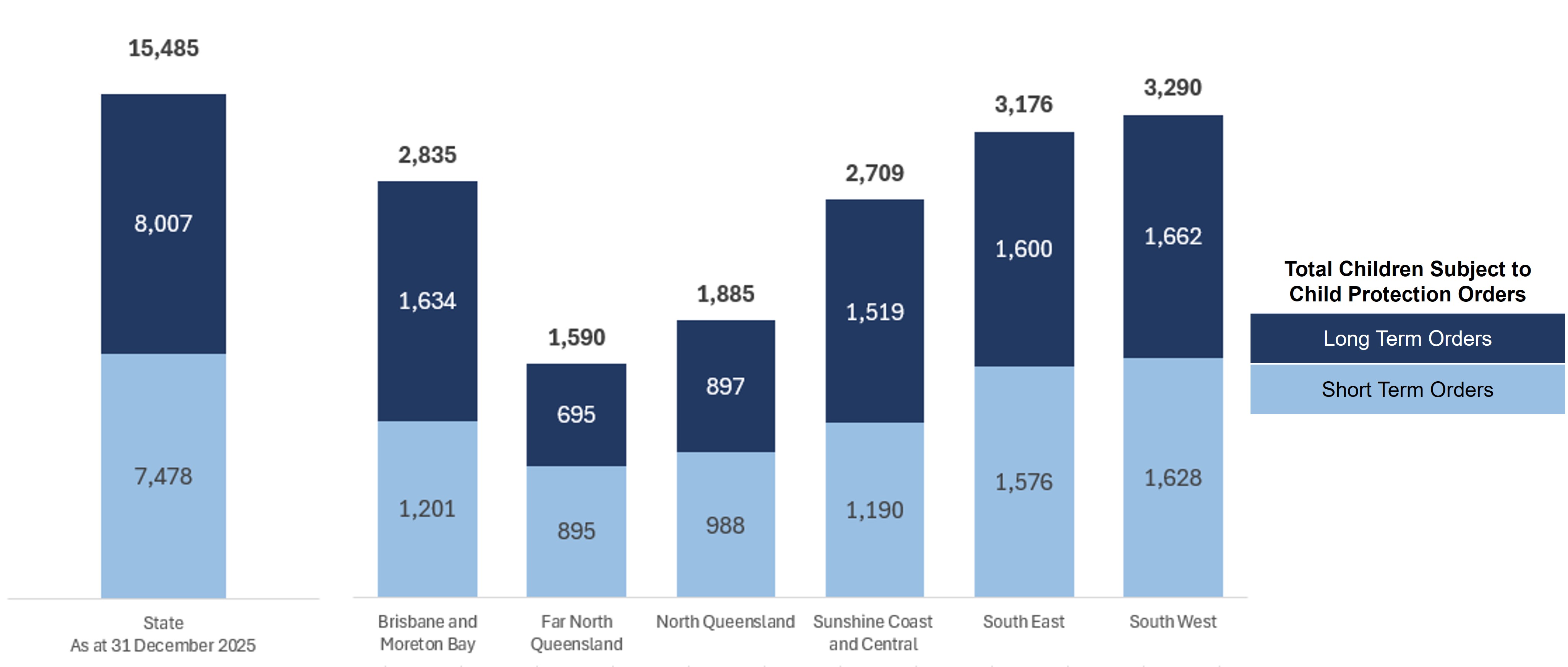
- This data shows the number of children subject to Child Protection Orders, statewide, by order type (short- or long-term).
- Reflects the point-in-time situation as at 31 December 2025.
- Delays in orders and adjournment information being received from the courts impacts accuracy and reliability of data. Operational data also includes orders made under Sections 67 and 99 of the Child Protection Act 1999 (interim orders), and Permanent Care Orders. The operational data is higher than the corporate data count for this reason.
- ‘Long-term order’ category includes Permanent Care Orders.
- Data exclusions: Excludes matters held in locations other than Child Safety regions (numbers are very low).